The Skill That Matters More When AI Writes Your Code
Saadaan Hassan • September 21, 2026 • 7 min read
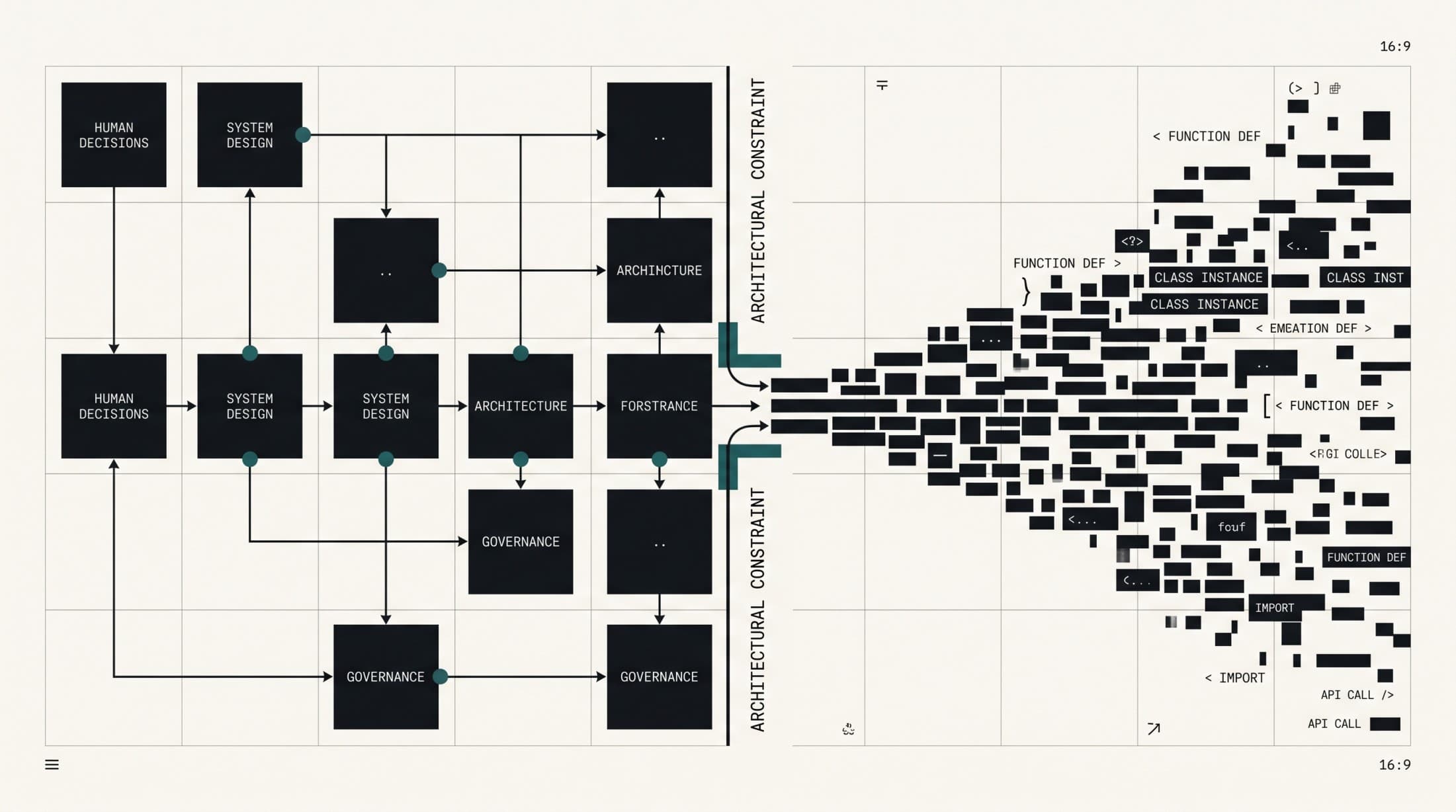
For the last few years, becoming a better developer largely meant becoming better at writing code.
Learn the framework.
Understand the language.
Memorize the APIs.
Practice algorithms.
Build enough projects that implementation becomes second nature.
That still matters.
But AI coding agents are changing the economics of software development.
Today, I can describe a feature to an agent, give it access to a repository, and watch it implement database changes, API endpoints, UI components, validation, tests, and even deployment configuration.
The interesting part is not that AI can write code.
The interesting part is what happens to the developer's role when writing the code is no longer the most expensive part of building software.
The implementation bottleneck is disappearing
A typical feature used to look something like this:
Idea
  ↓
Design
  ↓
Architecture
  ↓
Implementation
  ↓
Testing
  ↓
Debugging
  ↓
Deployment
Implementation could consume a large portion of the entire process.
With capable coding agents, that distribution is changing.
The agent can handle much of the mechanical work:
- Creating files and components
- Writing API endpoints
- Connecting database models
- Implementing authentication flows
- Generating tests
- Refactoring repetitive code
- Reading documentation
- Debugging straightforward issues
- Updating dependencies
- Writing configuration
That doesn't mean software engineering has become easy.
It means the difficult parts are moving.
Knowing what to build becomes more valuable
Consider a simple requirement:
"Add notifications to the application."
There are dozens of ways to implement that.
Should notifications be:
- Stored permanently?
- Delivered through WebSockets?
- Sent through email?
- Pushed to a mobile device?
- Processed asynchronously?
- Retried when delivery fails?
- Deduplicated?
- User-configurable?
- Eventually consistent?
The agent can implement almost any of these.
But it cannot magically determine which one is appropriate for the product.
That requires understanding the system.
The real engineering question is not:
"Can this be implemented?"
It is:
"What should we actually implement, and why?"
That distinction becomes increasingly important as coding becomes more automated.
Architecture becomes an interface between humans and agents
One of the biggest changes I've noticed in AI-assisted development is that architecture is no longer just documentation for humans.
It becomes context for the agent.
A good architecture gives an agent boundaries to operate within.
For example, instead of telling an agent:
Build authentication.
You can give it a system with explicit boundaries:
Frontend
   ↓
API
   ↓
Authentication Service
   ↓
User Database

External Identity Provider
   ↓
Authentication Service

Background Worker
   ↓
Email / Notifications
Now the agent has constraints.
It knows where authentication belongs.
It knows which layer should communicate with the database.
It knows where asynchronous work should happen.
It knows what should not be coupled together.
The better the boundaries, the less likely the agent is to make locally convenient decisions that create problems later.
AI doesn't remove technical debt
It can actually make some forms of technical debt easier to create.
An agent can produce 5,000 lines of code surprisingly quickly.
But speed doesn't guarantee coherence.
You can end up with:
- Multiple implementations of the same concept
- Inconsistent error handling
- Unnecessary abstractions
- Poor database boundaries
- Over-engineered infrastructure
- Duplicated business logic
- Dependencies that aren't actually needed
- APIs that work but don't fit the broader system
The code may compile.
The tests may pass.
The feature may work.
And the architecture can still be wrong.
That's why "the code works" is becoming a weaker definition of success.
The developer's job is moving up the abstraction ladder
I don't think AI makes developers irrelevant.
I think it changes which parts of development deserve the most attention.
There is a progression:
Writing code
    ↓
Understanding code
    ↓
Designing systems
    ↓
Making trade-offs
    ↓
Understanding products
    ↓
Making good engineering decisions
AI is increasingly capable of helping with the lower levels.
The higher levels still require context.
For example, an agent might suggest Redis because caching could improve performance.
But should you actually introduce Redis?
Maybe.
Or maybe your application has 500 users, the database query is already fast enough, and adding another infrastructure component creates operational complexity that provides almost no value.
The technically impressive solution isn't always the correct solution.
Sometimes the best engineering decision is the boring one.
I care more about decisions than typing speed
This has changed how I personally approach development.
When working with coding agents, I spend less time thinking:
"How do I write this?"
And more time thinking:
"What should this system look like?"
Before implementation, I want to understand things like:
- What are the actual requirements?
- What are the system boundaries?
- Where does the data live?
- What owns this piece of business logic?
- What happens when something fails?
- Does this need to be asynchronous?
- What are the security implications?
- What happens when the application grows?
- Is this abstraction actually necessary?
- What is the simplest architecture that solves the problem?
Once those decisions are clear, implementation becomes much easier to delegate.
The agent becomes an extremely capable implementation partner rather than the person deciding what the system should be.
This also changes what it means to learn
There is an interesting tension here.
AI makes it possible to build things without knowing every implementation detail.
That's incredibly useful.
But it can also make it easy to avoid learning those details entirely.
If an agent always writes your database queries, you can gradually become less comfortable with SQL.
If it always configures your infrastructure, cloud architecture can become a black box.
If it always handles authentication, you may understand the concept of authentication without understanding how the implementation actually works.
That's dangerous.
You don't need to manually write every line.
But you should understand enough to challenge the implementation.
If an agent proposes an architecture, you should be able to ask:
Why?
If it introduces a dependency:
Why do we need this?
If it adds a queue:
What problem does this solve?
If it creates another service:
Why can't this remain inside the existing service?
If it chooses a database structure:
What are the consequences when the data grows?
You don't have to type everything.
You still need to understand what everything means.
The new bottleneck is judgment
Software development has always involved judgment.
AI just makes it more visible.
When implementation takes days, poor architectural decisions may be hidden inside the amount of work required to change them.
When implementation takes hours, changing direction becomes much cheaper.
That means we can iterate faster.
But faster iteration also means we can make bad decisions faster.
The advantage doesn't come from blindly accepting AI-generated code.
It comes from being able to evaluate it quickly.
A strong AI-assisted developer therefore needs two capabilities at the same time:
The ability to use AI to move quickly.
And:
The ability to recognize when AI is moving in the wrong direction.
The second one is harder to automate.
Software engineering isn't disappearing. It's becoming more architectural.
I don't think the future of software development is humans versus AI.
I think it's humans directing increasingly capable systems.
The developer who can only write code manually may become slower.
The developer who can only prompt an AI may become dependent on whatever the AI suggests.
The more interesting skill set sits somewhere in between:
Product understanding
        +
System design
        +
Technical judgment
        +
AI-assisted implementation
        +
Ability to verify the result
That combination is powerful.
The goal isn't to prove that you can write every line yourself.
The goal is to build the right thing, with the right architecture, at the right level of complexity, and understand enough of the implementation to trust it.
AI makes writing software faster.
It doesn't make deciding what software should exist any easier.
And I suspect that distinction will become one of the most important skills in software engineering over the next few years.
More Blogs

Enjoyed this one?
Get in touch if you're building something and want a second opinion on the architecture.